
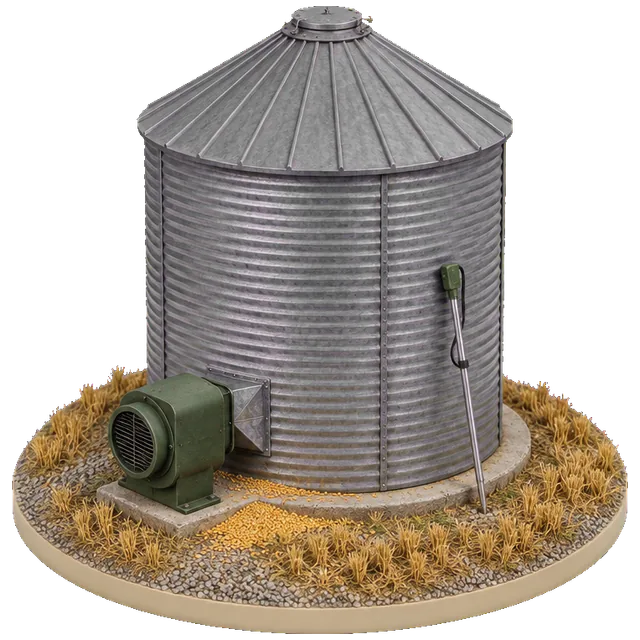
Short answer: Bin it dry and cool it down fast. For long-term storage, canola should be 8% moisture or less and under 15°C (Canola Council (opens in a new tab)), and wheat under 14.5% and 18°C (CGC (opens in a new tab)). Then check bin temperatures every two weeks (CGC (opens in a new tab)), and act if a bin holds steady or warms while the weather cools.
Dry enough to sell isn’t always dry enough to store
Canola grades straight at 10% moisture or less and wheat at 14.5% or less (CGC (opens in a new tab)). Storage asks for more. The Canola Council’s long-term target is 8% and under 15°C, and at 25°C even 8% is too wet (Canola Watch (opens in a new tab)).
Aeration cools grain but doesn’t dry it, and natural-air drying only works when the outside air can take on moisture (Saskatchewan’s drying factsheet (opens in a new tab)). If neither can bring a bin down, that’s when heated-air drying is used (Canola Council (opens in a new tab)).
Know the signs of trouble
- A bin that holds its temperature, or warms up, while the weather cools (Canola Watch (opens in a new tab)).
- Damp grain near the top, where warm air rising through the bin condenses on the cold seed (Canola Council (opens in a new tab)).
- Small, flat, reddish-brown beetles about 2 mm long: the rusty grain beetle (CGC (opens in a new tab)).
Watch canola most closely in its first six weeks in the bin (Canola Council (opens in a new tab)). Temperature cables can miss a small hot spot, so Canola Watch recommends unloading about a third of the bin and checking the canola as it comes out (Canola Watch (opens in a new tab)).
If you find insects, identify them, then cool and turn the grain, and treat it only if you need to (Manitoba (opens in a new tab)). A licensed elevator can’t accept infested grain (CGC (opens in a new tab)).
Check bins from outside. Never go in alone: lock out the unloading equipment, wear a harness tied off outside the bin, and have someone outside who can stop the equipment and call for help. In flowing grain a person can be buried in about 20 seconds (University of Saskatchewan (opens in a new tab)).
Keep a record of every check
Write down each bin’s moisture, temperature and condition with the date, so the next person knows when it was last looked at and what they found. In Kernl, Check grain records a bin’s moisture and a Ready or Check condition with the date, and Work can hold the next round of checks as a job with a due date. Kernl doesn’t read temperature cables or store temperatures; it keeps the moisture and condition you record, with the date.
Questions farmers ask
- Is 10% canola safe to store?
- Only if it stays cold. Canola Watch says 10% is probably safe only at 5°C or colder (Canola Watch (opens in a new tab)), and for long-term storage the target is 8% (Canola Council (opens in a new tab)).
- Does cold weather kill bugs in stored grain?
- Not quickly. Most insects stop feeding below 18°C, but killing them takes about a week at −20°C or eight weeks at −10°C, (CGC (opens in a new tab)). The rusty grain beetle is one of the most cold-tolerant (CGC (opens in a new tab)).
- Should I run the aeration fan in the fall?
- Yes. The Grain Commission says to aerate as soon as you can after harvest (CGC (opens in a new tab)), and the Canola Council says to cool canola again whenever the outside air is 5 to 10°C colder than the grain (Canola Council (opens in a new tab)).