
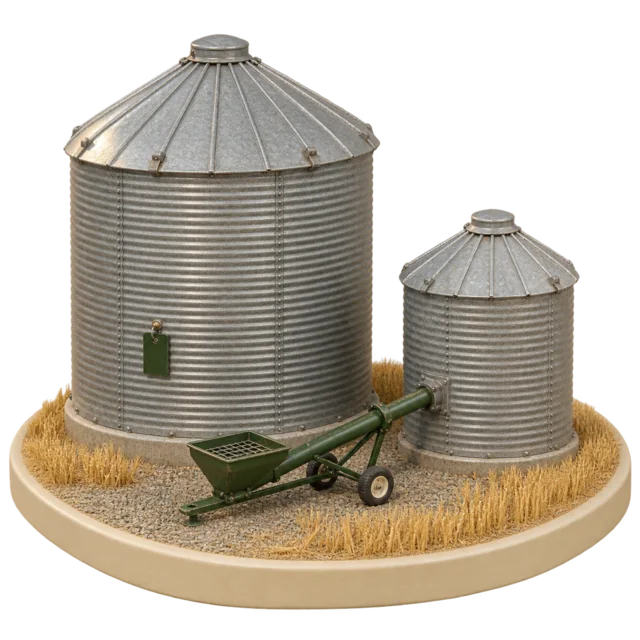
Short answer: Keep one count per bin with the date, the amount and whether it was measured or estimated, and record every load in or out. Then keep the buyer’s credited weight next to your own for each load, because the two often differ.
Start with a number you trust
You’ve got a truck coming and two bins with canola in them. Which one can fill the load? A number in the bin book helps, as long as you know when it was recorded and whether it came from a scale or an estimate.
Give each bin a name everyone uses. Start with the crop, the amount, the date and where the number came from. An estimate from last fall is still useful. Just leave it marked as an estimate.
How do you estimate bushels in a round bin?
Check stored grain from outside the bin. Grain can bury a person in seconds, and a crusted surface can give way under you. If entry is unavoidable, follow the farm’s site-specific confined-space entry and rescue procedures and applicable provincial requirements. See University of Saskatchewan grain entrapment guidance (opens in a new tab) and Saskatchewan farm safety guidance (opens in a new tab).
If you can get the dimensions and grain depth safely from outside, estimate the volume of the grain, not the capacity on the bin plate. A round bin with a flat grain surface is a cylinder: floor area times grain depth. Allow for a peak, a hollow or a hopper when the grain shape differs. AFSC’s storage measurement guide (opens in a new tab) shows the math for a flat bin, a cone-shaped pile and a hopper bottom. If you can’t get a depth safely, leave the quantity uncertain until you have better evidence.
A volume estimate and a commercial weight conversion answer different questions. For volume to mass, use an appropriate measured test weight for that lot. To compare weights with a buyer, use the bushel weight they use. AFSC’s conversion table (opens in a new tab) lists the factors AFSC uses for crop insurance, and those can differ from an elevator’s, especially for oats and barley. The Grain Commission’s test-weight guide (opens in a new tab) explains why you shouldn’t assume every bin bushel weighs the same.
What should you write down when grain moves?
When grain goes in, moves between bins or leaves the yard, record the date, crop, amount and bins involved. If you have a scale or load reference, keep it with the entry. Record a transfer once, with both bins named, so it doesn’t look as if grain disappeared from one side of the yard.
Keep moisture and temperature readings dated too. Rising readings can signal heating or spoilage. Use equipment that lets you monitor from outside; the Canadian Grain Commission explains what to watch for in its stored-grain monitoring guide (opens in a new tab).
How do you match bins to scale tickets and settlements?
Keep two numbers for that load: how much grain actually left the bin and how much the buyer credited. In a fictional example, the farm has reliable evidence that 20 tonnes left the bin and the buyer credits 19.6 tonnes after dockage. The physical movement is 20 tonnes. The contract credit is 19.6 tonnes.
Use reliable physical-weight evidence to correct a bin estimate if you get it. Keep the buyer’s ticket with the same load and check the credited weight, grade and deductions against the settlement. If the bin’s balance still doesn’t make sense, start with the last reliable count and look for a missing load or one side of a transfer before recording a correction.
Paper or a spreadsheet can work if the next person can follow the numbers. In Kernl, you can mark each bin quantity as measured or estimated. Kernl keeps the record of what you entered and why you corrected it; it doesn’t measure the bin or adjust the grain for moisture or dockage.
Questions farmers ask
- Why doesn’t my bin count match the elevator ticket?
- The elevator removes dockage before it grades your grain, and if it dries your grain it can deduct drying charges and moisture shrink (CGC (opens in a new tab)). Bushel weights vary too, so there’s no single bushels-per-tonne figure for a crop (CGC (opens in a new tab)).
- How often should I check stored grain?
- The Canadian Grain Commission says to check bin temperatures every 2 weeks (CGC (opens in a new tab)). Watch canola most closely in the first six weeks after harvest (Canola Council (opens in a new tab)).
- Are temperature cables enough?
- They help, but one cable covers roughly a 20 to 24 foot circle, so wider bins need at least three (Canola Council (opens in a new tab)), and cables can miss small hot spots (Canola Council (opens in a new tab)).